
Categories
Education Technology

How Finland is preparing its citizens for a world swamped by fake news

Finland has been ranked a world leader in media literacy for years. Children as young as kindergarten age are being taught to handle the disinformation they will encounter online. We talked to Kari Kivinen, the European Union Intellectual Property Office’s (EUIPO) education outreach expert. A former headmaster in Helsinki, he has contributed to shaping Finland’s media literacy education.

Experts worldwide have been calling for better media literacy to counter the spread of fake news. But while little has been done in many countries, Finland has actually taken action: In 2014, media literacy became part of the national curriculum for pupils of all ages. How were you able to take such decisive action?

It has to do with the Finnish education system, which is unique in many ways. We swim against the current global tide in education, which involves focusing on core subjects, competition and control. We place greater emphasis on general competencies than on testable knowledge. These competencies are outlined in the national core curriculum, which is regularly updated.

Finnish students’ performance has consistently scored higher than the OECD average and the socio-economic gap is narrower. Can you tell me more about the Finnish education system?

Every child in Finland has the right to free, quality education, regardless of where they live. We have a unified comprehensive school system to ensure that every child receives the same education and opportunities, the idea being for there to be no barriers: pupils receive free meals, books and transport. Teaching is a very popular profession, so universities are really free to pick the best candidates to train for this career. There is also a great deal of trust in schools, with heads and teachers themselves monitoring the quality of education rather than bringing in external inspectors to do so. I’ve been a head teacher in Finland myself and we take this side of the job very seriously.

What happened in 2014?

The new National Core Curriculum was introduced and multiliteracy became one of what we call “transversal education areas”. This means that every teacher, whether they teach PE, English or maths, is required to promote multiliteracy in all age groups. 

Multiliteracy is defined as the ability to obtain, process and verify information. Why is this such a high priority?

In Finland, media and information literacy is considered a basic civic competence for democracy. It is promoted not only by schools, but also by libraries, NGOs and lifelong-learning institutions. And we foster this skill from an early age, as even most pre-school children have already been exposed to digital media: They have seen films and advertisements, listened to music, and some have played computer games. We want to show them how to use digital media devices in a balanced and civilised way. 
Categories
Education Technology

Global Alliance and $30M Investment to Transform Ukraine’s Early Childhood and Preschool Education

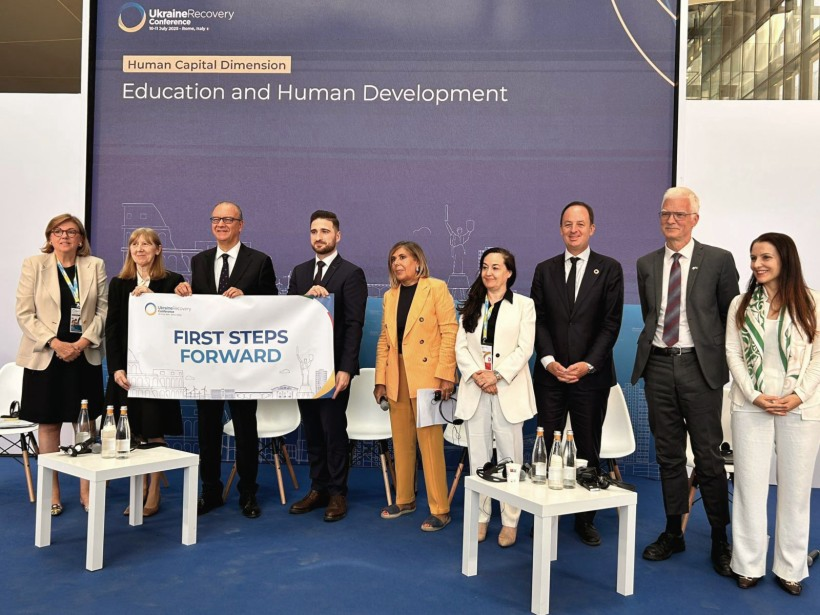
Rome, 11 July 2025 — A new international alliance of more than twenty partners — including UNICEF, the World Bank, GPE, UNESCO, OECD — has been launched to support Ukraine’s “First Steps Forward” initiative to transform Early Childhood and Preschool Education (ECPE), increase investment in the sector as well as enhance technical assistance and expertise for preschool education.

As part of this effort, the World Bank has made an initial contribution of $30 million to promote inclusive access to ECPE, enhance teaching and learning practices and conditions, and strengthen institutional and local capacities for ECPE management. 

The announcements were made through a Joint Statement at the Ukraine Recovery Conference (URC 2025) to highlight the importance of prioritizing ECEP. The launch took place with the participation of Yevhen Kudriavets, First Deputy Minister of Education and Science of Ukraine, Antonella Bassani, Vice President of the Europe and Central Asia Region, World Bank, Regina De Dominicis, UNICEF Regional Director for Europe and Central Asia.

“Human capital is every country’s most valuable resource — and early childhood education is key to developing it. Over the past months, we have taken an important step in this direction: a new law on early childhood education has been adopted, and a regulatory framework has been developed that significantly transforms the system.

With support from the World Bank and partner countries, we aim to restore access to education lost due to Russian aggression and build a modern, resilient system that meets the needs of every child,” said Oksen Lisovyi, Minister of Education and Science of Ukraine.

“Since the start of the full-scale invasion, early childhood education in Ukraine has faced severe disruptions. Over 320,000 children — more than 20% of preschoolers — lack access to in-person learning, and enrolment has dropped by 25% since 2021. Many preschools have been damaged or destroyed, and the system urgently needs modernization. Supporting this sector is a strategic priority for Ukraine’s recovery. We are grateful to all partners who have joined us in this mission,” added Yevhen Kudriavets, First Deputy Minister of Education and Science of Ukraine.

To address this, the Ministry of Education and Science of Ukraine together with international partners has developed a Strategic Framework for Early Childhood and Preschool Education as part of the “First Steps Forward” initiative. The newly established alliance will collaborate to implement the strategy and support Ukraine’s recovery and long-term development by investing in one of the highest-return sectors — Early Childhood and Preschool Education (ECPE). The Strategic Framework focuses on key priorities:

  • Expanding and adapting infrastructure and service models to meet safety and demographic realities
  • Introducing flexible formats (e.g. mobile kindergartens, home- or workplace-based care)
  • Expanding access for all children, including those with disabilities
  • Improving teacher training and working conditions
  • Increasing parental and community engagement
  • Implementing digital systems for service planning and delivery

One of the shared targets is to ensure that by 2030, at least 45-50% of children under age 3 and 96% of children aged 3 to 6 are enrolled in high-quality early childhood services — in line with the EU’s Barcelona Targets.

“This framework is an opportunity to work together to ensure that every child in Ukraine has access to quality, inclusive, and flexible early learning and care,” said Regina De Dominicis, UNICEF Regional Director for Europe and Central Asia. “UNICEF is committed to support the Government and its partners to turn this vision into reality – an essential step for the country’s recovery and long-term resilience.”

The “First Steps Forward” initiative is already endorsed by EU member states, leading financial institutions, organizations including Finland, Belgium, Lithuania, the World Bank Group, UNICEF, UNESCO, Global Partnership for Education and others. The full list of organizations can be found here.

It is expected to expand over time, with new partners joining on a regular basis.

Nowadays, Ukraine has a unique alignment that enables meaningful change in early childhood education. We invite all interested partners to join this effort — by sharing expertise, offering financial support, or contributing to the implementation of the “First Steps Forward” initiative.

For partnership inquiries: partnership@mon.gov.ua

The initiative is implemented with the assistance of the Partnerships Coordination Office of the Ministry of Education and Science of Ukraine.